About studying opening theory
Opening theory (joseki) is a set of model opening sequences, drawn from a huge number of past games, that say "in this position, this move is strong." Seeing the commentary on professional games or thick books of opening theory, some of you may despair, thinking you can't win unless you memorize this much.
But don't worry. At the amateur level (that is, almost all of humanity), and especially when you are aiming for 1-dan, you hardly need to study opening theory.
The reason is simple. In amateur games, what decides the result is far more reading accuracy and endgame strength than detailed opening knowledge.
No matter how much of an advantage you get in the opening, it means nothing if you can't finish the job in the endgame or you get turned around. Conversely, if your endgame strength is far above your opponent's, you can almost always come back from a somewhat worse position.
Also, even without much opening knowledge, if you can read moves accurately and carefully from the opening, you should be able to get through the opening safely enough, if not perfectly.
In the opening, think of it as fine as long as you don't make big mistakes, such as letting your opponent suddenly make a tokin or having a silver captured for free. Of course, you may make such mistakes, but as you gain experience, they will become rarer even without focused study.
Also, even if you memorize opening sequences, your opponent often won't follow them, or will use a surprise strategy (an unusual, non-mainstream strategy), so your opening knowledge often can't be used.
Just "a few rough shapes" is enough
That said, knowing nothing at all is unsettling, so if you keep just one or two "shapes or castles you can fight with confidence," you will hesitate less in the opening.
In my case too, I basically just build a Gangi or Crab Castle against Static Rook opponents, and a Boat Castle against Ranging Rook opponents. After that, I play only on experience and reading at the board. I have not done any systematic research.
Even so, I have reached 4-dan with improvised play alone.
Even now, the games I lose are more often caused by mistakes in the middlegame, or by a lack of reading accuracy and tsume skill in the endgame, than by a lack of opening knowledge.
Rather than poring over opening books, what I recommend is reflecting on the positions where you went wrong in the openings of your own games.
In fact, for kyu players, the real benefit of studying opening theory lies largely in absorbing the essence and feel of the opening. For example:
- You attacked too early and it failed
- Your formation was scattered and you got hit by a quick attack
- Your opponent promoted their bishop early in the opening
If you fix failures like these one by one, you should pick up a certain feel for the opening even without studying opening theory!
Note
This article is an excerpt and adaptation from my book Shogi Beyond the Rules. That book is packed with immediately useful content, from thinking tips like the ones in this article to techniques for winning real games.
If you found this interesting or useful, I would be very happy if you took a casual look at the book.
📚 Available free for Kindle Unlimited members!
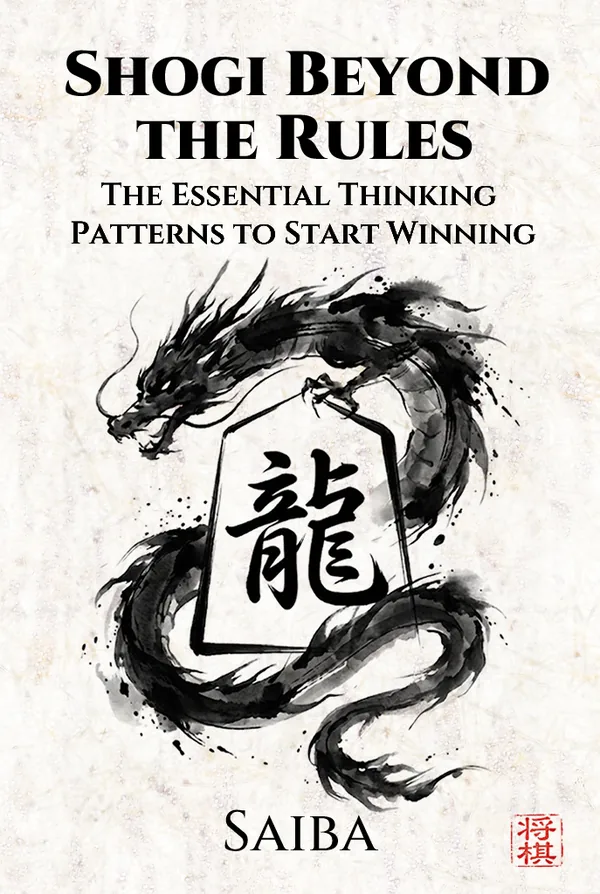
Shogi Beyond the Rules — Think Better, Play Better, Win More
Available on Kindle Unlimited. A practical thinking guide for players who know the rules but still can't win.
View on Amazon